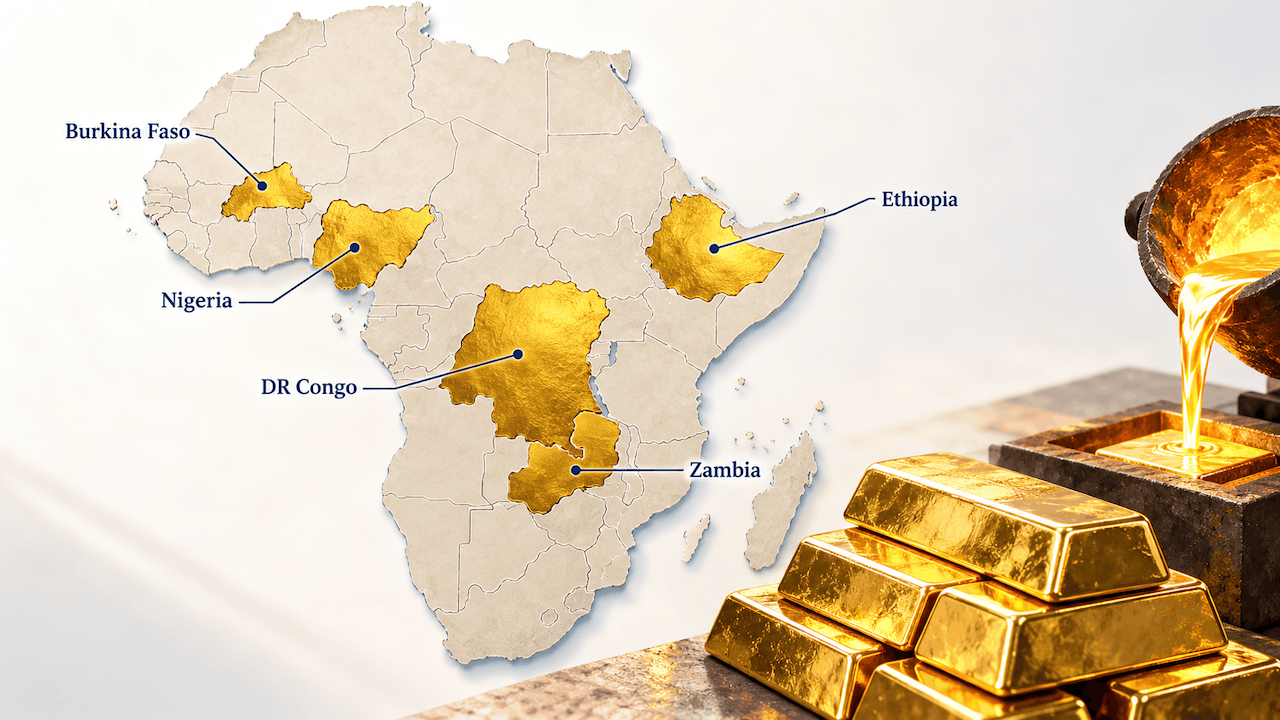
(Mike Maharrey, Money Metals News Service) Five countries have opened gold-refining facilities as African gold producers seek to keep more of their wealth at home.
As it stands, large amounts of raw gold ore leave Africa for refining. The gold later returns to the continent as imports in the form of coins, bars, and jewelry.
Zambia is the latest country to welcome a gold refining facility. According to Business Insider Africa, Minera Refineries Zambia Limited operates the facility, which can refine gold up to 99.99 percent purity.
According to the Zambian Observer, the company believes the facility will generate more than $1.8 billion in economic value.
African Business Insider reports that the new refinery is expected to “capture more value from its gold production, formalize small-scale mining, and diversify its mineral exports.”
Gold accounts for about $262 million in Zambian exports, about 2 percent of the country’s total.
Zambian officials say the refinery will also help formalize artisanal mining. These are small-scale operations generally run by individuals, families, or small groups using simple tools and minimal mechanization. These mines often operate outside of any regulatory structure.
The hope is that a competitive local buyer and refinery could bring more production into recorded exports and the tax system.
Minera Refineries Zambia Limited managing director Andrew Mukupa Katandula recently outlined a 2-year plan to formalize artisanal mining in Zambia. The scheme includes “targeted pre-financing” for miners and improved transparency in gold production and trade.
Zambia is just the most recent African country to enter the gold processing game.
Earlier this month, a gold refinery opened in Ethiopia. State-owned Ethiopian Investment Holdings holds a majority stake in the $50 million joint venture. It will provide services, including melting, testing, refining, casting, bar minting, and die-making.
Prime Minister Abiy Ahmed said the facility will process gold from Ethiopia and elsewhere.
“It enables neighboring countries and regional mining companies to bring their gold to Ethiopia for advanced refining, certification, value addition, and sale, eliminating the need to export it outside the continent.”
Officials say the refinery will process more than 600 tonnes of precious metal annually.
Gold exports serve as one of Ethiopia’s primary sources of foreign exchange, earning the country $5.6 billion during Ethiopia’s 2025/26 fiscal year.
A month earlier, state-owned Raffinerie Nationale d’Or du Burkina Faso began operations in Ouagadougou. According to Business Insider Africa, this facility will process, assay, certify, and store gold domestically, with an initial capacity of around 515 tonnes per year.
Gold accounts for nearly 94 percent of Burkina Faso’s export earnings.
President Ibrahim Traoré said the refinery will help the country move beyond mineral extraction and “develop the full value chain locally.” He went on to say, “Our ambition goes beyond gold.”
“We want to make the mining sector a driver of industrial transformation.”
Meanwhile, a high-purity gold refinery opened in Lagos, Nigeria, in January, and in the Democratic Republic of the Congo in March.
African leaders hope development of domestic refining capacity will keep more African wealth in Africa. It could also drive job creation and boost local gold jewelry production.
Mike Maharrey is a journalist and market analyst for Money Metals with over a decade of experience in precious metals. He holds a BS in accounting from the University of Kentucky and a BA in journalism from the University of South Florida.