(Ben Seevers, Money Metals News Service) It is becoming more common for those on the right to be skeptical or downright hostile to free markets. Since President Trump entered the political scene over a decade ago, conservatives have increasingly abandoned free market principles.
The same is true for the religious right. Vice President JD Vance, a Catholic and presumptive successor to President Trump, has been a vocal opponent of free market principles throughout his career in the US Senate and the Trump administration. On the academic side, Patrick Deneen, a political philosopher at the University of Notre Dame, has decried free markets in favor of wealth redistribution.
While the religious right is turning against free markets, it is important to remind ourselves what Christian theologians of the past have taught on the matter. Let us look at what they thought about monetary policy.
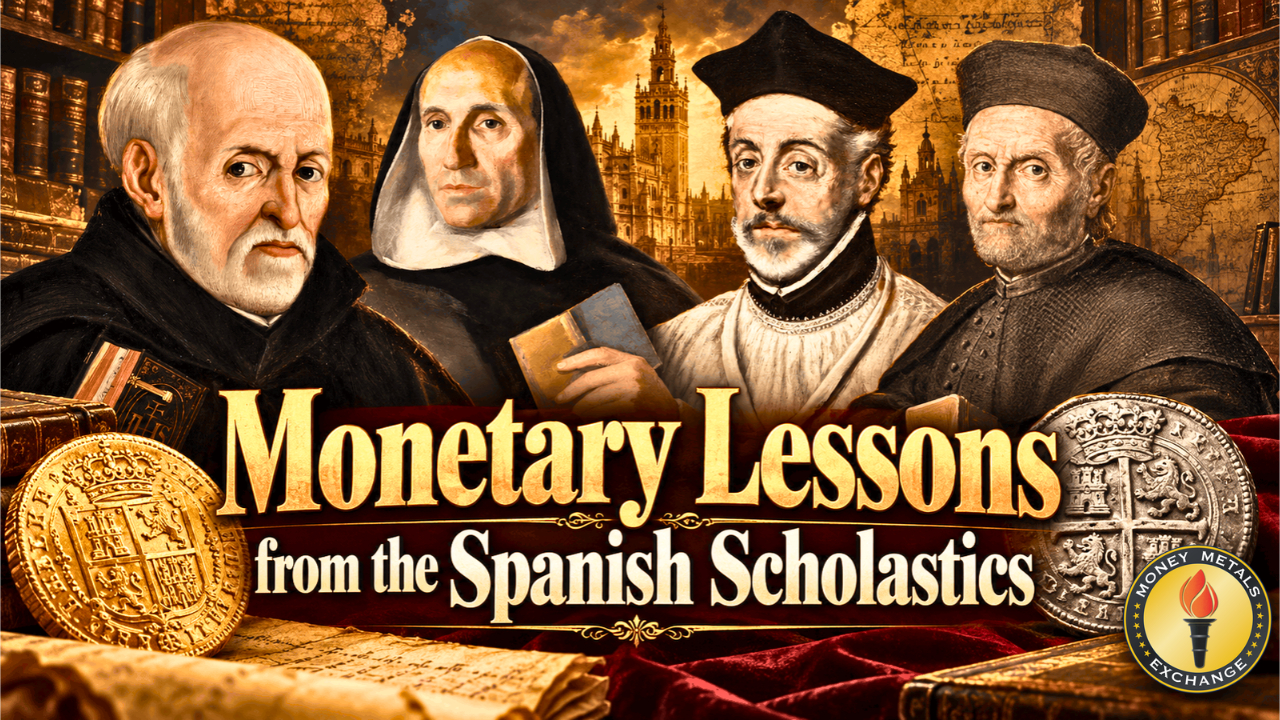
We will examine one group of theologians from the period of Late Scholasticism (16th and 17th centuries): the Spanish Scholastics. These theologians were mainly writing from the School of Salamanca. The father of their school of thought was Francisco de Vitoria (d. 1546), commonly known as “the father of international law” and famous for writing against the enslavement and horrible treatment of the native people of the New World.
They were occupied with many questions related to commerce. In many ways, they had the welfare of commercial society at the forefront of their minds. This concern was made clear in their dedication to sound money.
The Spanish Scholastics recognized the value of money. Juan de Mariana (d. 1624) argued that when the legal value of money decreases, prices are sure to increase. Fellow scholastics Martín de Azpilcueta (d. 1586) and Bartolomé de Albornoz (d. 1573) agree with Mariana–-the cause of high prices is the abundance of money. The Spanish Scholastics were therefore ahead of their time in understanding that inflation is, as Milton Friedman said, “always and everywhere a monetary phenomenon.”
For the Spanish Scholastics, money was some kind of precious metal—silver or gold. Paper currency divorced from a metallic standard was not yet a live possibility, so the ability of the government to increase the quantity of money was restricted relative to today, where paper fiat currency is almost a fact of life.
Governments were not fully powerless at that time. They could debase the money by diluting its metallic content, changing the shape, altering the legal value, etc. They recognized that inflation was something of a tax, and since they believed that governments had the right to tax for necessary revenues, they also acknowledged that there may be circumstances where debasement is necessary. However, they restricted the government’s ability to do so to crises and, this is remarkable, Mariana believed the government (the king in this case) would have to make restitution to the people for the damage done.
Mariana, at least, believed that the government should not be let off the hook for its monetary mischief, but is this the general opinion of the Spanish Scholastics? Tomás de Mercado (d. 1575) stated that the durability and invariability of the value of money was “necessary for good government and peace in the kingdom.”
Domingo de Soto (d. 1560) also affirmed that money should be “firm and fixed” or else the government may lose the trust of its subjects. Not trusting the government itself can lead to distrusting and not having confidence in the legal order. If the government consumes the value of money, what else will it consume?
More can be read about the Spanish Scholastics and the above arguments in Alejandro Chafuen’s Faith and Liberty: The Economic Thought of the Late Scholastics. It should be noted that many of their arguments concerning money are drawn from older writers such as Aristotle and Thomas Aquinas. It is clear from these thinkers and the writings of the Spanish Scholastics that sound money was important to them not only from an economic perspective, but also from the perspective of Christian morality. Departing from sound money through monetary inflation is akin to theft, which violates Christian tenets, such as thou shalt not steal (Exodus 20:15).
What lesson should we take from the teaching of the Spanish Scholastics on money? The religious right, rather than being tempted by the interventionism peddled by their thought leaders and politicians, must look back to what the moral and economic experts in the Christian tradition have said. Rather than being allured by short-term political gains of weak money, we must pursue a policy of sound money.
To the Spanish Scholastics, this meant a metallic money, or at the very least a money untouched by government policy. Inflation should be curbed by avoiding debasement of the currency, and if the government is pressed by necessity to debase, it must compensate the people for the damage done. This advice is radical relative to the present situation but sobering.
Benjamin Seevers is an economics PhD student at West Virginia University. Ben was a summer fellow in 2023 and 2025 at the Mises Institute. He earned his bachelor’s degree in economics with a minor in philosophy from Grove City College.