(Mike Maharrey, Money Metals News Service) The Debt Black Hole keeps getting bigger.
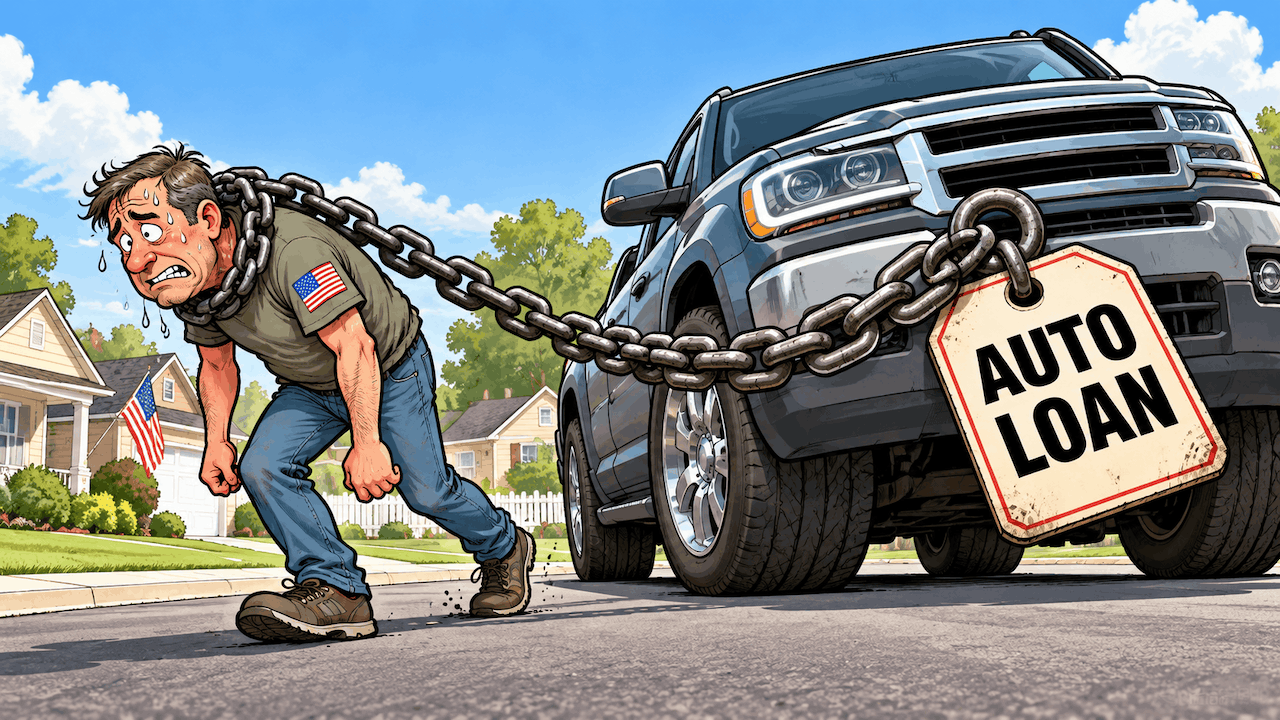
American auto loan payments just hit an all-time high of $787 per month.
Pile that on record credit card debt and relentless price inflation, and it’s no wonder American consumers feel stressed!
Rapidly rising vehicle prices (thanks, inflation!) combined with higher interest rates are driving car ownership costs ever higher.
The average price of a new car has eclipsed $50,000, according to Kelley Blue Book. That’s up by about 30 percent in just six years.
Meanwhile, the average APR on a new car loan hovers around 7 percent.
That is a recipe for skyrocketing car payments. A record 21.2 percent of new vehicle buyers in Q3 ended up with payments of $1,000 or more.
On top of that, car owners are making those payments for longer periods.
Just over a quarter of new car loans carried terms of 84 months or more, according to Edmunds. That’s up from 23.9 percent in Q2 and 21.8 percent a year ago.
The average auto loan term is currently around 67.9 months. For folks like me who aren’t good at doing math in their heads, that’s 5.7 years.
Things aren’t much better in the used car market. The average used car buyer borrows $30,703 at 10.6 percent APR.
Carnegie Mellon University’s Tepper School of Business assistant teaching professor Helen Colby told Fortune these huge auto loans are squeezing household budgets.
“For borrowers who already have tight budgets, getting such a long loan means committing themselves to five, six, or even seven years of increased spending that will reduce their budget for other things like vacations, savings, or even necessities like food and clothing.”
A Breaking Point?
Eventually, consumers will reach a breaking point. And we may be getting close.
Subprime borrowers are already feeling the stress. More than 30 percent of subprime auto loans originated in the first half of 2026 won’t be paid off until the vehicle is 12 years old. That’s up from just 7 percent in 2019.
Meanwhile, 1 in 5 Americans is behind on at least one auto loan. That’s the highest level since 2010, at the height of the Great Recession.
This is why a Reuters headline declared, “The $1.7 trillion auto loan market heads for a crash.”
This massive debt not only drags down the economy (people paying $700 a month on their car loan have less money to buy other things), but it also creates systemic risk.
Auto loans are often bundled into asset-backed securities. This allows asset managers, pension funds, and insurance companies to invest in this debt.
In practice, lenders bundle thousands of auto loans and sell investors securities backed by the borrowers’ payments.
If this sounds a little like subprime mortgages in the early 00s, well…
According to Fitch Ratings, the share of subprime loans backing ABS that are 60 days or more past due has risen to a record level over 6 percent. According to S&P Global, it is a “colossal” market with $127 billion of securitized issuance in 2025.
What happens if the subprime auto market implodes as the housing market did in 2008?
The two situations are certainly similar. Lenders extended credit to riskier borrowers, bundled the loans into securities, and sold them to investors. However, the much smaller scale of the subprime auto market mitigates systemic risk. Total U.S. auto debt stood at about $1.71 trillion in June 2026, compared with $13.1 trillion in mortgage debt, and subprime auto loans represent only part of that much smaller auto market.
While a subprime auto meltdown is less likely to spiral into a broader financial crisis like the 2008 subprime mortgage collapse, it could still kick off chaos in the financial system.
And this is just a small part of the massive Debt Black Hole dominating the economy. Consumers aren’t the only ones straining under record debt burdens; the U.S. government is also buried under over $40 trillion in debt, and it just ran the third-largest deficit in history. Meanwhile, corporations are leveraged to the hilt and corporate bankruptcies are surging.
Keep this in mind the next time you hear a financial news commentator pontificating about the Federal Reserve raising interest rates to battle price inflation. It’s not that simple. Raising rates would jack up borrowing costs even higher.
Americans can’t afford it.