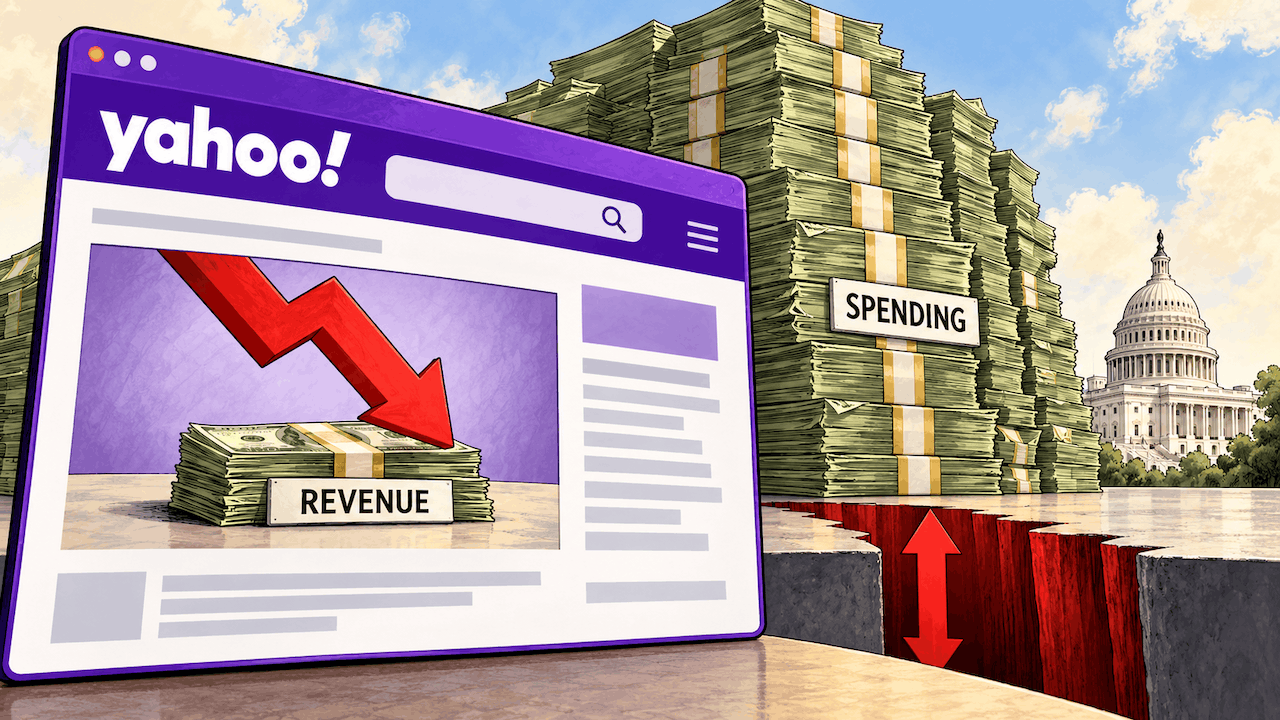
(Mike Maharrey, Money Metals News Service) I ran across a glaring example of mainstream media bias that I want to highlight for you.
Accusations of “fake news” are often overplayed. However, mainstream media bias is a thing, and you should be aware of it, even in financial news reporting.
On Friday, the Treasury Department released the September 2026 Monthly Treasury Statement, revealing the federal government ran a deficit of nearly $2 trillion. It was the third-largest budget shortfall in history.
Democrats like to blame large budget deficits on tax cuts, and Yahoo Finance Washington Correspondent Ben Werschkul was bound and determined to advance this narrative.
The problem is: it isn’t true.
Ben isn’t a greenhorn reporter. According to his bio, he “covered Washington for over 20 years as a reporter and video producer, working previously at The New York Times and CNN.”
I can’t help but note that the Times and CNN are notorious for left-wing bias. Apparently, Ben packed some in his bag and headed over to Yahoo Finance.
The reporting in the top half of his story is pretty standard and unobjectionable. Werschkul highlighted the deficit data and put it in context with the surging national debt. He accurately described federal spending growth. He also noted the rapidly increasing interest expense and the impact of tariffs.
So far, so good.
And then our intrepid reporter launched into a subsection headlined “Revenue downturn.”
Let’s just pause here for a moment.
When you read that subheading, you naturally assume that federal revenues fell last year, right?
Hold that thought.
The first paragraph of this subsection reads:
“The revenue side of the U.S. government’s budget equation has also faltered on some fronts in 2026, in part due to tax cuts implemented by Trump’s ‘One Big Beautiful Bill.’”
There you have it. Revenue fell because the Republicans cut taxes! It’s the standard left-wing argument.
Werschkul then launched into an overview of Congressional Budget Office (CBO) analysis, noting that tariff revenue declined along with corporate income tax collections.
“The group calculates that corporate income taxes decreased by 16% in 2026 as the new tax cuts allowed corporations to take larger deductions ‘and offset the increases in those receipts that otherwise would have been expected, given the rise in corporate income.’”
This paragraph feels intentionally confusing. What does this really mean?
Let’s break it down:
- Corporate income rose last year.
- Provisions in the One Big Beautiful Bill allowed corporations to take larger deductions.
- Corporate tax revenue fell 16 percent year-on-year despite rising corporate income.
On a side note, there’s an unspoken assumption baked into this argument – that corporate income would still increase absent the tax cuts. However, tax cuts tend to stimulate economic activity. Tax relief may well have stimulated business and increased corporate income. In other words, the tax cuts weren’t all bad. While the Trump tax cuts may have squeezed revenue through more deductions and lower tax rates, they may have also boosted revenue through economic growth. You would need an in-depth economic study to determine the net impact.
But for the sake of argument, let’s assume that Werschkul’s spin is correct and revenue was 16 percent lower than it otherwise would have been. Did that cause a massive budget deficit?
To be fair, that’s not the only factor Werschkul considered. He noted the tariff debacle squeezed federal revenue after the Supreme Court ruled Trump’s edicts unconstitutional.
“This turnabout in tariffs led to a deficit approximately $140 billion higher than projections from just a few months ago.”
That’s it. That completes Werschkul’s analysis of federal revenue.
Given this information, what would you conclude?
It’s pretty obvious that the federal government had a big revenue problem because Trump is a big dummy.
But Werschkul left something out of his reporting.
Nowhere in his article does this seasoned reporter tell you exactly how much revenue the federal government collected compared to last year. He mentions total revenue in the first paragraph, but this is no context.
Isn’t that at least a little bit relevant here?
If you’re wondering, Uncle Sam took in $5.4 trillion in receipts. That was 3.2 percent more than it collected in 2025.
Wait. What?
When you read Werschkul’s article, you almost certainly come away thinking the federal government ran a bigger deficit because it collected less money. After all, Trump cut taxes. However, even with tax cuts, federal revenue grew!
And by the way, U.S. federal receipts climbed 6 percent in 2025, and 11 percent in 2024.
This is not a revenue problem.
It’s a spending problem.
Federal outlays grew by 5.5 percent in 2026.
For the life of me, I can’t figure out how a veteran reporter left out the fact that revenue increased and didn’t even mention total federal receipts. I’ll let you speculate on the reasons.
I do have one caveat.
This may not be Ben’s fault.
He may have included the revenue information, and the editor cut it out. If that’s the case, the editor is just really bad at his job or has an agenda to advance.
I should also note that Werschkul probably didn’t write the misleading “Revenue downturn” subheading. Copyeditors generally write headlines, not reporters.
But let me reiterate, this is an egregious subheading. There was no overall revenue downturn. Revenue was up. If an editor inserted something like that into my story, I would throw a royal fit.
Why?
Because it’s not true.
Consider the ramifications.
Thousands, if not millions, of people read this article. They now believe federal revenue was down last year.
This is a great example of media bias at work. Ben didn’t write anything untrue (The awful subheading he probably didn’t write notwithstanding). He merely left out relevant information. Call it a sin of omission.
But this kind of stuff shapes thinking, and you need to be aware of it. You would be wise to read stories from multiple sources, including those that may not confirm your point of view.
Mike Maharrey is a journalist and market analyst for Money Metals with over a decade of experience in precious metals. He holds a BS in accounting from the University of Kentucky and a BA in journalism from the University of South Florida.