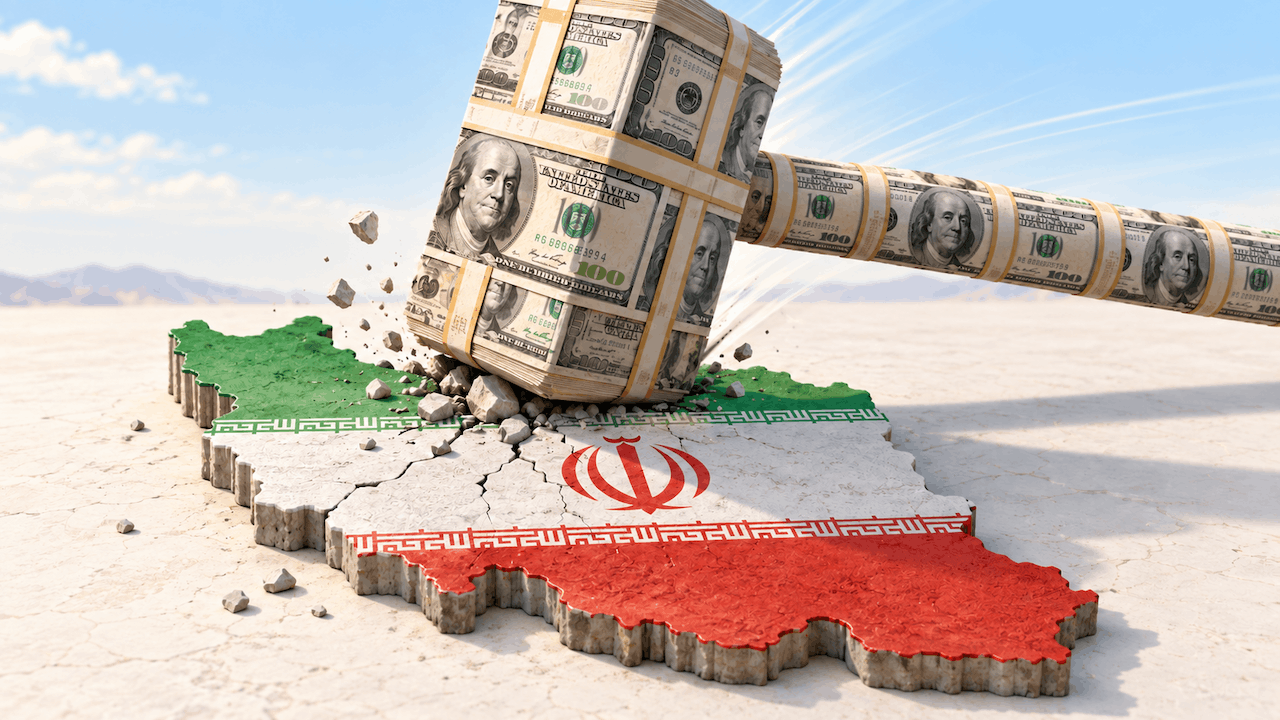
(Mike Maharrey, Money Metals News Service) The U.S. government continues to ratchet up its use of the dollar as a foreign policy tool, even as the weaponization of the dollar has accelerated de-dollarization.
On Monday, U.S. Treasury Secretary Scott Bessent announced plans to effectively ground Iran’s commercial airlines, saying that on Wednesday, Sept. 23, “All the Iranian airlines will be shut down around the world.”
In pursuit of this goal, Bessent warned that any company or country supporting Iranian airlines could face secondary sanctions and be “knocked out” of the dollar system.
“If they land, you cannot provide them with fuel, you cannot provide them with landing services, you cannot sell them tickets, or you will be knocked out of the dollar system.”
Sanctions targeting Iranian domestic airlines are part of broader measures to ratchet up pressure on the Iranian regime and isolate the country from the global financial system. The U.S. has reportedly threatened secondary sanctions on foreign companies that do business with Iran across a wide range of sectors, including energy, shipping, precious metals, crypto, and manufacturing.
Thanks to the dollar’s reserve currency status, the U.S. can back up these threats. Much of the global economy runs on dollars, and governments or companies that cross Washington risk having access to that system restricted or cut off. The U.S. government can exert this pressure by freezing assets under U.S. jurisdiction, limiting dealings with U.S. companies, and restricting foreign banks’ access to U.S. banking accounts.
Under a series of executive orders issued by President George W. Bush after 9/11 and more recently by President Trump, entities supporting sanctioned countries can also be designated as sanctions targets and added to the Office of Foreign Assets Control’s (OFAC) Specially Designated Nationals and Blocked Persons List.
Persons or entities on that list can have their property and funds within the U.S. frozen and be blocked from doing business with U.S. individuals or companies. More significantly, foreign banks that service sanctioned entities can face sanctions themselves, including losing access to the U.S. banking system.
The U.S. has another sanction tool in its belt. With Western cooperation, the U.S. can cut off sanctioned entities from SWIFT.
The Society for Worldwide Interbank Financial Telecommunication (SWIFT) system serves as the global economy’s superhighway. In effect, it operates as a global financial messaging service, facilitating cross-border payments. As the SWIFT website puts it, “SWIFT is the way the world moves value.”
Since the dollar serves as the world reserve currency, SWIFT effectively facilitates an international dollar system.
The threat of sanctions incentivizes foreign governments, companies, and banks to drop Iranian business rather than risk much wider financial disruption.
However, the dollar weaponization creates other perverse incentives. It motivates them to limit their exposure to the dollar system. After all, if somebody is threatening to pull a rug out from under you, the smart move is to get the rug out of the room.
Enter de-dollarization.
Many countries have seen the writing on the wall. Not wanting to be under the U.S. government’s thumb, they’ve started taking steps to limit their exposure to the dollar and dollar assets. After all, the U.S. can’t sanction your dollar activities if you don’t have any.
We see this evidence in central bank gold buying.
Central bank gold buying ramped up after Russia invaded Ukraine.
The U.S. and its allies immediately imposed economic sanctions on Russia, and they escalated quickly. Officials initially indicated Russia would not be locked out of SWIFT. A few days later, the United States, the European Union, the UK, and Canada issued a joint statement announcing SWIFT would disconnect “selected” Russian banks from the global payment system.
In the ensuing months, the U.S. and its allies continued to tighten this economic noose.
Meanwhile, gold overtook U.S. Treasuries as the top global reserve asset.
We also see the implications of de-dollarization in the shaky bond market. Demand for U.S. Treasuries has tanked in recent months. Long-term bond yields have risen to levels not seen since 2007. The U.S. has been forced to intervene in the bond market to push rates down. (It hasn’t worked.)
One could certainly argue that sanctions are a necessary foreign policy tool. However, as with any policy, it’s important to count the cost and anticipate potential blowback.
De-dollarization potentially creates economic problems for the U.S. that are every bit as bad as the consequences facing sanctioned countries.
Simply put, the United States depends on the global demand to underpin its bloated government. De-dollarization threatens an inflation tsunami as those unwanted dollars make their way back to the U.S.
The dollar’s role as the world’s reserve currency is the only reason the U.S. can borrow, spend, and run massive budget deficits to the extent it does. It creates a built-in global demand for dollars and dollar-denominated assets. This absorbs the Federal Reserve’s money creation and helps maintain dollar strength despite the Federal Reserve’s inflationary policies.
But what happens if that demand drops?
A de-dollarization of the world economy could cause a dollar glut. The U.S. currency could further depreciate. At the extreme, global de-dollarization could spark a currency crisis. You and I would feel the impact through higher price inflation, eating away at the dollar’s purchasing power. In the worst-case scenario, it could lead to hyperinflation.
President Trump and his Treasury secretary are playing with fire. They’d best be careful lest they get burned.
Mike Maharrey is a journalist and market analyst for Money Metals with over a decade of experience in precious metals. He holds a BS in accounting from the University of Kentucky and a BA in journalism from the University of South Florida.