
(The Center Square) The U.S. Department of Homeland Security had a budget of about $31 billion in its first full year of operation. For 2027, the Trump administration wants $118 billion.
Created in 2003 in the wake of the Sept. 11, 2001, terror attacks by folding 22 agencies into a single cabinet department, the Department of Homeland Security has become a permanent part of the federal government, and one that is getting bigger. Adjusted for inflation, its budget has grown substantially over its first two-plus decades, although it has held relatively steady as a share of the economy. What is harder to establish, 25 years after the attacks that created it, is what taxpayers have gotten for the money.
Estimates of the total overall cost run into the trillions. The Committee for a Responsible Federal Budget, drawing on White House budget data, puts spending from 2003 through 2025 at roughly $1.4 trillion in actual outlays, or about $1.7 trillion in budget authority. The department itself says Congress has appropriated about $1.6 trillion from 2003 through 2026, counting discretionary funding, mandatory accounts, fees and the disaster relief fund. The figures differ because they count different things over different years, but they agree on the order of magnitude: securing the homeland has cost more than a trillion dollars.
Much of that money has little to do with terrorism. The attacks of Sept. 11, 2001, triggered the department’s creation, but DHS today is largely not a terrorism-prevention agency, said Amy Pate, director of the National Consortium for the Study of Terrorism and Responses to Terrorism at the University of Maryland. Most of its budget goes to missions such as border and immigration enforcement, customs, cybersecurity, critical infrastructure and disaster response. Some terrorism-prevention work has been scaled back. In 2025, DHS eliminated $18.5 million in grants from its Center for Prevention Programs and Partnerships, calling them wasteful and disconnected from counterterrorism, a move researchers in the field viewed as a loss.
The Department of Homeland Security has struggled to fully account for its spending for its entire existence. The Government Accountability Office has kept DHS financial and information-technology management on its “high-risk” list for years, and it remains there. DHS has earned a clean audit opinion on its financial statements for 13 consecutive years, but its auditor issued an “adverse” opinion for 2025 on the department’s internal controls over financial reporting, the systems meant to ensure the numbers can be trusted, citing weaknesses in five areas.
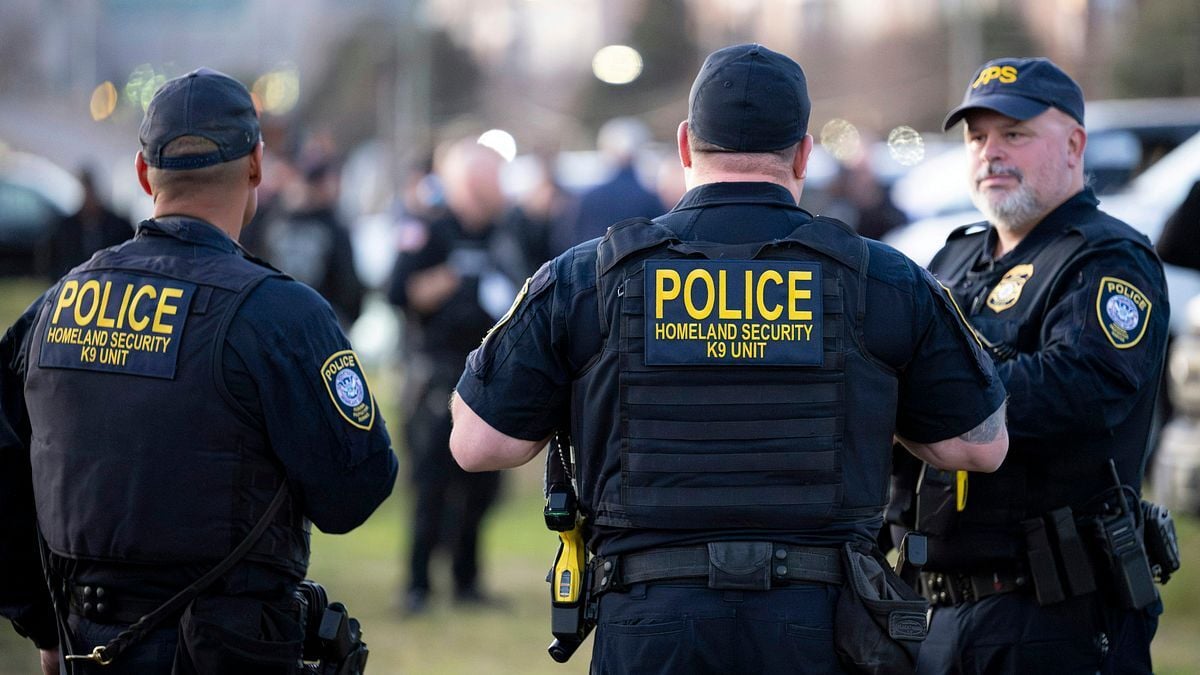
DHS Federal Protective Service K9 unit officers work to secure the Super Bowl at Caesars Superdome in New Orleans on Feb. 1, 2025. Photo: Tia Dufour / U.S. Department of Homeland Security / Public Domain
The department has also struggled to control the cost of what it buys. In a review released this year, GAO examined 27 major DHS acquisition programs, each worth more than $300 million. Of the 19 that had approved baselines, 15 had revised those baselines, most of those revisions delaying delivery, and their combined projected costs had grown by $11.4 billion, or 26%, over initial estimates.
DHS offered technical comments on the acquisition review, and when GAO faulted the department in a separate report for unreliable schedules in its financial-system modernization, DHS concurred with all five recommendations. None has been closed.
That’s not a new pattern. At a 2017 House Homeland Security subcommittee hearing pointedly titled “DHS Financial Systems: Will Modernization Ever Be Achieved?”, the subcommittee’s chairman, U.S. Rep. Scott Perry said the department had already sunk more than $50 million into two failed attempts to build an integrated financial system. Costs of a third effort climbed from $79 million to more than $124 million. A GAO official testified that DHS could keep its books clean only “through continued reliance on compensating controls and complex manual workarounds.” Nearly a decade later, the GAO’s assessment has barely changed.
To some, that track record is the problem.
“DHS has received a steadily increasing supply of taxpayer resources, yet that funding has failed to deliver,” said David Ditch, a federal budget analyst at the Cato Institute.
Ditch told The Center Square that the department’s cost has grown faster than inflation without a matching improvement in security. To put the price in simpler terms, Ditch calculated that the 2025 DHS budget consumed the equivalent of the entire annual income of more than 1.2 million typical American households.
Ditch pointed to failures across the department. The Transportation Security Administration, he said, regularly fails its own covert screening tests, and has “become more of a jobs program than a security service.”
The department defends its spending. Its budget growth since 2003 reflects “more than two decades of inflation, workforce and operational costs, technology and asset modernization, disaster response needs, and an increasingly complex threat environment,” a DHS spokesperson told The Center Square.
The department “views this funding as an investment in national security, public safety, resilience and mission readiness,” the spokesperson said, and pointed to a mission that spans border security, immigration enforcement, cybersecurity, disaster response and countering fentanyl trafficking.
Measuring what the money bought is harder than measuring what it cost. Backers of the post-9/11 buildup point to the absence of another large-scale foreign attack on U.S. soil as evidence it worked; skeptics counter that it is impossible to prove a negative. But the threat that justified the spending has not gone away.
“Twenty-five years ago, our enemies were foreign, and we only had to worry about the threat from one very prominent foreign terrorist organization, al-Qaeda,” Bruce Hoffman, a senior fellow for counterterrorism and homeland security at the Council on Foreign Relations, wrote this month. “Today, it’s not just al-Qaeda, but also ISIS and all the franchises and branches they’ve spawned, as well as significant threats of domestic terrorism from both the far left and the far right. This is a much more complex threat environment we face today than we did a quarter of a century ago.”
Twenty-five years on, the department born from the deadliest terrorist attack in American history has grown into a permanent, trillion-dollar enterprise touching nearly every corner of national life. What it has not done, by the account of Congress’s own watchdog, is build the financial systems and controls needed to ensure its books can be trusted.