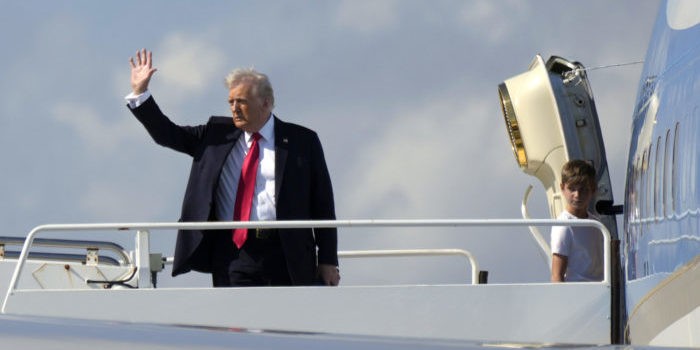
(Ken Silva, Headline USA) Last month, President Donald Trump reportedly switched airplanes at the last minute when leaving a NATO summit in Turkey, due to a purported assassination threat coming from Iranian proxy forces. Instead of flying on a jet donated to him by the Qatari government, Trump was said to have used an older version of Air Force One because it has better defensive capabilities.
It turns out, Trump’s maneuvering was even more clandestine that originally reported. Not only did he switch to the older Air Force One; he was also secretly smuggled off that plane inside a catering container and taken to a third plane, according to the Washington Post and the New York Times.
Trump then took the third plane, a military aircraft, to the UK before being smuggled back onto the older Air Force One via the catering cart. Once in Britain, he departed Air Force One in front of the media, who were none the wiser about what had happened.
“The elaborate plan appears to have been developed in a matter of hours after officials determined that a threat against Mr. Trump from Iran was credible,” the Times reported Monday, citing two anonymous sources. “It came after years of threats against Mr. Trump from Iran and amid the war he launched against that country. And it was an unusual instance of the public being deceived about a president’s whereabouts.”
The story of Trump's decoy planes is even crazier: Not only did he switch off his original Qatari jet. He was secretly smuggled off the older Air Force 1 inside a catering cart. He then flew to Britain on a military jet before being smuggled back onto Air Force 1. https://t.co/HdecWrYfjp pic.twitter.com/p6pjGy0gr5
— Ken Silva (@JD_Cashless) August 11, 2026
Trump’s secretive maneuvering came after Israel briefed the U.S. with purported intelligence about an Iranian plot to assassinate him. The Times said the decision to switch planes in Turkey stemmed from different intelligence than what the Israelis were providing. The Times added that some U.S. officials believe that the Israeli intelligence was intended to convince Trump to escalate his war against Iran.
Officials have yet to provide any evidence of a credible Iranian assassination attempt against Trump. This author’s book on the Trump assassination attempts details how the FBI and Israel manufactured dubious evidence that Iran was threatening him—though admittedly the threats may be more legitimate now amidst a full-fledged war between the countries.
There were two assassination attempts against Trump in 2024. One occurred on July 13, 2024, in Butler, Pennsylvania, when 20-year-old Thomas Crooks allegedly shot him in the ear from a rooftop during a campaign rally. The other occurred about two months later at Trump’s Palm Beach golf course, where North Carolina man Ryan Routh was spotted by Secret Service hiding in the bushes with an SKS-style rifle a mere few hundred yards away from Trump.
Additionally, a gunman tried storming the White House Correspondents’ Dinner event earlier this year in an apparent attempt to kill Trump and other officials. Trump was on a separate floor from the alleged gunman, Cole Allen, when law enforcement apprehended him.
There’s no evidence that any of those attempt were sponsored by Iran.
The FBI did arrest a Pakistani national named Asif Merchant on July 12, 2024—the day before Trump was shot—for murder-for-hire in an alleged plot to assassinate U.S. officials, including possibly Trump.
However, Merchant’s actions can hardly be called an assassination attempt. Rather, the available evidence suggests that Merchant was the target of a highly controlled FBI sting operation, and that he never posed a threat to Trump.
Indeed, the U.S. was monitoring Merchant before he even entered the U.S. in April 2024, and officials let him into the country to track him and see where he’d go.
Moreover, an FBI informant drove Merchant around while he was here, and introduced him to two undercover agents posing as “hitmen.” Merchant allegedly paid those two agents $5,000 as a downpayment for his plot—which also included staging a protest and stealing documents—and he was arrested as he was attempting to leave the country.
Merchant was found guilty in March.
The FBI did accuse one other man of being involved in an Iranian plot against Trump in a criminal complaint filed in November 2024. In that case, there’s arguably even less evidence of a credible threat to Trump.
Indeed, the defendants in that case—Farhad Shakeri, 51, of Iran; Carlisle Rivera, also known as Pop, 49, of Brooklyn, New York; and Jonathon Loadholt, 36, of Staten Island, New York—were not accused of conspiring to kill any politicians, let alone Trump. Rather, they were charged with plotting to kill a U.S. journalist of Iranian origin.
While Shakeri is one of the defendants, the government’s criminal complaint shows that he appears to have been snitching to the FBI in recent months. According to the charging papers, Shakeri participated in phone interviews with the FBI from Iran on September 30, October 8, October 17, October 28 and November 7—ostensibly trading information in exchange for a sentence reduction for an unidentified individual.
In one of those interviews, Shakeri—who was deported from the United States in 2008 after serving fourteen years in prison for robbery—told the FBI that an Iranian Revolutionary Guard Corps official was pushing him to assassinate Trump.
Shakeri further told the FBI that the IRGC official told him on October 7 that he had to provide a plan to kill Trump within seven days. Shakeri said he was unable to do so, and so Iran decided to pause its plans to kill Trump until after the election—which would have made it easier to kill him if he lost.
The FBI admitted in the charging papers that Shakeri is a liar, but said his claims about Trump “appear to be truthful.” Nevertheless, when the Justice Department secured indictments in the case a month after the criminal complaint was filed, there was no mention of the allegation against Trump.
Loadholt and Rivera both pled guilty to conspiring against the journalist, while Shakeri remains at-large in Iran.
Ken Silva is the editor of Headline USA. Follow him at x.com/jd_cashless.