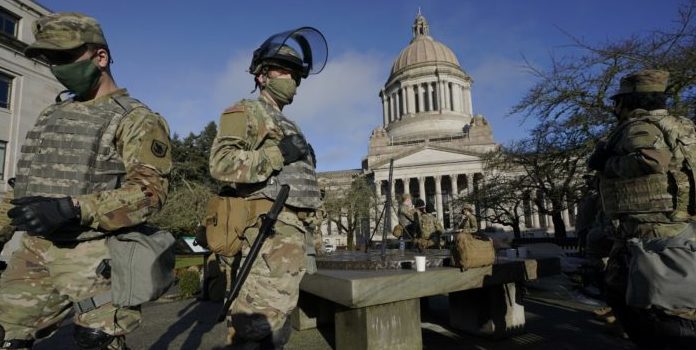
(The Center Square) Tuesday marks one year since President Donald Trump declared “Liberation Day” in Washington, D.C., leading to the deployment of the National Guard and the beautification of the nation’s capital.
On a typical, hot and humid Washington morning in August 2025, The Center Square was present in the White House briefing room that day, noting it was jammed packed with journalists stacked on top of each other awaiting the president’s briefing, as murmurs from some journalists in the room recounted personal and secondhand encounters with crime in the district, including muggings and property theft.
Trump entered the room, flanked by some of his top cabinet secretaries and administrators, including Secretary of War Pete Hegseth, then-Attorney General Pam Bondi, Secretary of the Interior Doug Bergum, and FBI Director Kash Patel, declaring a crime emergency in the district, announcing the deployment of the National Guard to curb crime.
The president claimed the city had been plagued with “crime, bloodshed, bedlam and squalor, and worse.” The president appeared to have had enough, expressing embarrassment as world leaders visited the district, with eyes fixed on homeless encampments, deteriorating infrastructure, and graffiti.
The president held up charts comparing the district’s homicide rate to other cities around the world, noting it was higher than that of other capital cities. The White House released a fact sheet showing the district’s 2024 murder rate per 100,000 in comparison to other nations’ capitals. America led the pack, nearly double second-place Bogota, Colombia, followed by Mexico City, Mexico, and Islamabad, Pakistan.
“This is Liberation Day in D.C., and we’re going to take our capital back,” said the president. “We’re taking it back under the authorities vested in me as the President of the United States. I’m officially invoking section 740 of the District of Columbia Rule Act.”
The president pointed to several examples of violence, including former Trump administration official Mike Gill, who was shot and killed in D.C. as part of a carjacking spree in 2024.
Since the Aug. 11, 2025, “Liberation Day” announcement, streets across the district continue to be patrolled by the National Guard, with the president saying he would like them to remain through his term, with the Department of War estimating it could cost $1.4 billion to extend the deployment through January 2029.
The crime crackdown in D.C. appears to be working, as evidenced by the numbers. The Metropolitan Police Department reports that overall crime is down 20% in the last year, with homicide rates down 32%; robbery down 16%; motor vehicle thefts down 53%; theft from auto down 36%; and total property crime down 22%.
In a snapshot from the Washington Metropolitan Area Transit Authority, ridership is up from one year ago. On July 30, 2025, Metro rail logged 492,689 boardings; on July 30, 2026, it logged 518,390 boardings. Metro bus also saw a rise, with 352,249 riders on July 30, 2025, compared to 360,031 on July 30, 2026.
Weeks before the “Liberation Day” announcement, the president laid the foundation for cracking down on homeless encampments across the district through the signing of an executive order aimed at cracking down on homelessness.
Since the crime emergency was declared and the executive order was signed, Washington, D.C. has seen a 9.3% decrease in unsheltered residents, as reported by Street Sense Media, noting the “decline may reflect the impact of President Donald Trump’s federal takeover. Despite the decrease in the number of unsheltered individuals, D.C. reportedly saw a 4.4% increase in homeless individuals from 2025.
In addition to cracking down on crime, the president’s “Liberation Day” announcement paved the way for a Trump renaissance in the district, aiming to beautify the city by clearing out homeless encampments, restoring some of the city’s forgotten about landmarks, and setting out to construct monuments and additions to the White House.

Leading up to the nation’s 250th birthday celebration, the Trump administration oversaw the restoration of 22 fountains and 28 statues across the nation’s capital.
In August 2025, the president told reporters that he was requesting about $2 billion from Congress to clean up the city. However, he’s claimed private funds will also be used to build one of the White House’s most significant additions, the ballroom and a helipad currently under construction on the South Lawn.
However, the Trump administration is seeking $1 billion in taxpayer funds for security enhancements to the ballroom, including a landing pad for drones and an extensive underground military complex.
Trump also plans to build a 250-foot Triumphal Arch between Memorial Bridge and Arlington National Cemetery, described by the National Park Service as a “monumental structure honoring the nation’s 250th anniversary.”
“Drawing on the historic Roman precedent of erecting freestanding arches to celebrate civic achievement, the Arch is envisioned as a prominent addition to the capitals architectural landscape in the monumental core,” the park service added.
Axios estimates the arch could cost as much as $100 million to construct.
While Trump has touted the crime turnaround and beautification of the district in the last year, he hasn’t ruled out the possibility of seeking to rescind the District of Columbia Home Rule Act of 1973, which was enacted by Congress and ratified by D.C. voters. The act gave the district residents limited autonomy over local affairs, allowing them to elect local leaders, including mayors and council members.
The president remains uncertain about the district’s political future as Washington, D.C., prepares to elect a new mayor, with Democratic candidate Janeese Lewis George, a self-described democratic socialist, a likely favorite to win the race, as the district is heavily Democratic.