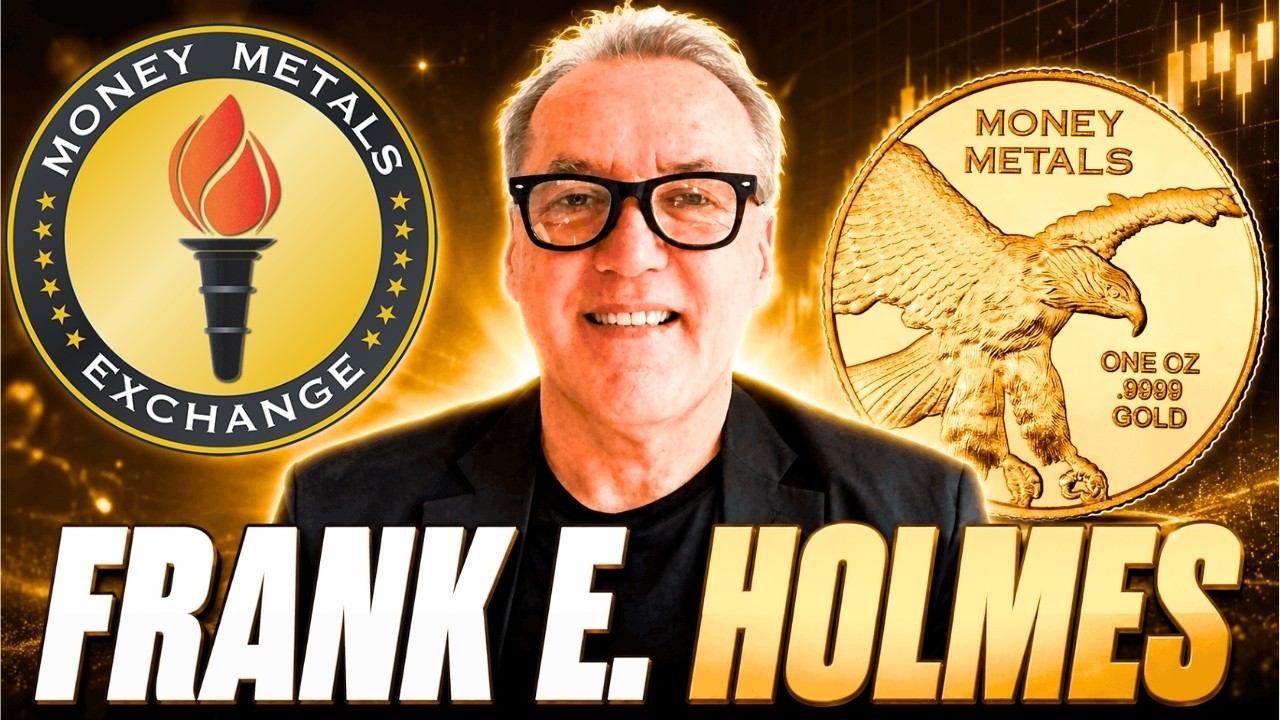
(Money Metals News Service) Despite months of sideways trading, Frank E. Holmes believes the gold bull market is alive and well. During a wide-ranging conversation with Money Metals’ Mike Maharrey, the executive chairman of HIVE Digital Technologies and CEO and Chief Investment Officer (CIO) of U.S. Global Investors argued that powerful global trends continue to support higher gold prices.
From Asian consumer demand and central bank buying to Japan’s interest rate shifts, artificial intelligence infrastructure, and rising government debt, Holmes outlined why he sees the current correction as a buying opportunity rather than the end of the bull market.
(Interview Starts Around 7:06 Mark)
The “Love Trade” Is Stronger Than the “Fear Trade”
Frank Holmes explained that gold demand is driven by two distinct forces: the “fear trade” and the “love trade.” Western investors tend to focus on fear-driven buying fueled by inflation, wars, monetary expansion, and financial instability. However, he argued that the larger and more durable driver comes from the love trade.
According to Holmes, roughly 60% of global gold demand comes from people purchasing gold as portable family wealth, particularly throughout Asia and the Middle East. Rising GDP per capita across countries such as China and India has dramatically increased gold ownership over the past two decades. In many emerging economies, physical gold functions as a form of financial insurance where traditional insurance markets are less developed.
Because of these cultural dynamics, Holmes believes every significant correction in gold is met with strong physical buying from Asian consumers, creating an important foundation underneath the market.
China, BRICS, and the Dollar’s Long-Term Challenge
Holmes also emphasized that global monetary shifts continue to favor gold.
He pointed to more than $350 trillion in global debt and ongoing adherence to Modern Monetary Theory (MMT)-style fiscal policies as long-term catalysts for precious metals. At the same time, he argued that China has steadily weakened the U.S. dollar’s international dominance through its Belt and Road Initiative and expanding influence among BRICS nations.
According to Holmes, approximately 75% of United Nations member countries now have financial ties to China through Belt and Road lending. That growing influence has encouraged more international trade to occur outside the traditional dollar system, reducing long-term demand for U.S. dollars while increasing interest in alternative reserve assets such as gold.
Japan May Be Driving More Than Investors Realize
One of Frank Holmes‘ biggest concerns centers on Japan’s changing interest rate environment.
For roughly 30 years, Japan maintained near-zero borrowing costs, allowing hedge funds, institutions, pension funds, and insurers to borrow cheaply in yen before investing in higher-yielding assets around the world. That so-called “carry trade” became a major source of global liquidity.
Now that Japan has begun raising interest rates following post-COVID inflation and supply chain disruptions, Holmes believes that money is beginning to flow back into Japan. As investors unwind those leveraged positions, markets ranging from technology stocks to gold experience selling pressure driven by margin calls rather than deteriorating fundamentals.
He noted that Japan holds one of the highest debt-to-GDP ratios among G7 nations, yet nearly half of that debt is owned domestically by the Bank of Japan. As Japanese capital returns home, Holmes expects the unwinding process to continue affecting markets worldwide.
AI Spending Suggests the Global Economy Remains Strong
Although technology stocks have experienced volatility, Holmes argued that the artificial intelligence boom is far from finished.
He highlighted Meta’s plans to build a $14 billion AI data center in El Paso, Texas, requiring approximately 50,000 tons of copper. Strong copper prices, he said, contradict the narrative that AI investment is collapsing.
Holmes also pointed to BlackRock’s willingness to invest roughly $10 billion into AI infrastructure, backed by sovereign wealth funds from countries including Norway, Saudi Arabia, and the United Arab Emirates. These enormous capital commitments suggest institutions continue viewing AI as a long-term supercycle rather than a speculative bubble.
To Holmes, copper’s continued strength reinforces that conclusion because rising industrial demand remains inconsistent with fears of an imminent AI collapse.
Quant Models Point to a Favorable Gold Setup
Rather than relying solely on macroeconomic forecasts, Holmes uses quantitative models to evaluate market conditions.
Frank Holmes explained that both gold and silver reached historically overbought levels earlier in the year, with silver moving approximately six standard deviations above its longer-term trend before futures exchanges increased margin requirements. Gold also experienced a significant correction as rising interest rates pressured prices.
After falling from roughly three standard deviations above trend to approximately 1.6 standard deviations below, Holmes said his models now indicate an approximately 85% probability that gold prices will be higher over the next 60 trading days.
He emphasized that this outlook comes from statistical market behavior rather than geopolitical predictions, arguing that markets naturally oscillate between periods of excessive optimism and excessive pessimism.
Why Rising Interest Rates Don’t Necessarily Hurt Gold
Mike Maharrey challenged Holmes on a common assumption: if interest rates remain elevated and bonds stay in a long-term bear market, shouldn’t that be bearish for gold?
Frank Holmes disagreed.
He argued that central bank gold buying—particularly among countries seeking to diversify away from the U.S. dollar—continues to provide substantial support. At the same time, governments facing mounting fiscal problems repeatedly resort to monetary expansion.
Holmes maintained that investors should hold at least 10% of their portfolios in gold and silver as financial insurance. While acknowledging that some vocal gold advocates own little or no physical metal themselves, he believes the underlying supply-and-demand fundamentals remain overwhelmingly favorable.
Will Central Banks Ever Stop Printing Money?
The discussion turned to speculation surrounding Kevin Warsh and whether future Federal Reserve leadership might maintain a tougher stance on inflation.
Holmes acknowledged that Warsh projects a more disciplined, fact-based communication style than previous Fed officials. However, he ultimately believes any major recession or financial crisis would lead policymakers back toward monetary stimulus.
He argued that the institutional culture within central banking overwhelmingly favors supporting economic growth through additional liquidity, making continued money creation more likely than prolonged monetary restraint.
That expectation reinforces Holmes’ long-term bullish outlook for gold, especially as governments continue expanding deficits.
Could Gold Eventually Reach $40,000?
Perhaps Holmes’ boldest projection involved the theoretical value of U.S. gold reserves.
Using a mark-to-market approach that compares America’s official gold holdings with total federal debt, Holmes suggested gold could approach $40,000 per ounce if policymakers sought to substantially improve the nation’s debt-to-gold ratio.
He also noted that China has increasingly emphasized physical gold ownership while reducing reliance on paper gold products. Holmes believes these policies strengthen demand for physical bullion while also giving the Chinese government greater oversight of domestic wealth.
Smart Beta Investing and Reading the Global Economy
Holmes also discussed his Smart Beta 2.0 investment process, which emphasizes revenue growth, cash flow momentum, and portfolio construction rather than simple stock selection.
For gold mining investments, he favors royalty companies while evaluating quarterly production and revenue growth relative to movements in gold prices.
Outside precious metals, Holmes watches cargo shipping and airline traffic as real-time indicators of global economic activity. He noted that roughly 80% of commodities move by cargo ship, while airline travel has surged from approximately 85,000 daily TSA screenings during 2020 back to roughly 3 million travelers per day.
Despite negative headlines, Holmes believes these indicators demonstrate that the global economy remains resilient.
Military Spending, AI, and Staying Ahead of Monetary Expansion
Frank Holmes concluded by arguing that government spending is increasingly shifting toward defense technology, cybersecurity, and artificial intelligence rather than traditional social programs.
He estimated that approximately $2.5 trillion could flow into military modernization and AI-related investments over time. Combined with continued monetary expansion, he believes these trends will continue creating opportunities across sectors tied to technology, commodities, and precious metals.
Rather than complaining about money printing, Frank E. Holmes encouraged investors to position their portfolios ahead of it. In his view, owning assets that benefit from inflationary policies—including physical gold—remains the most practical long-term strategy.